
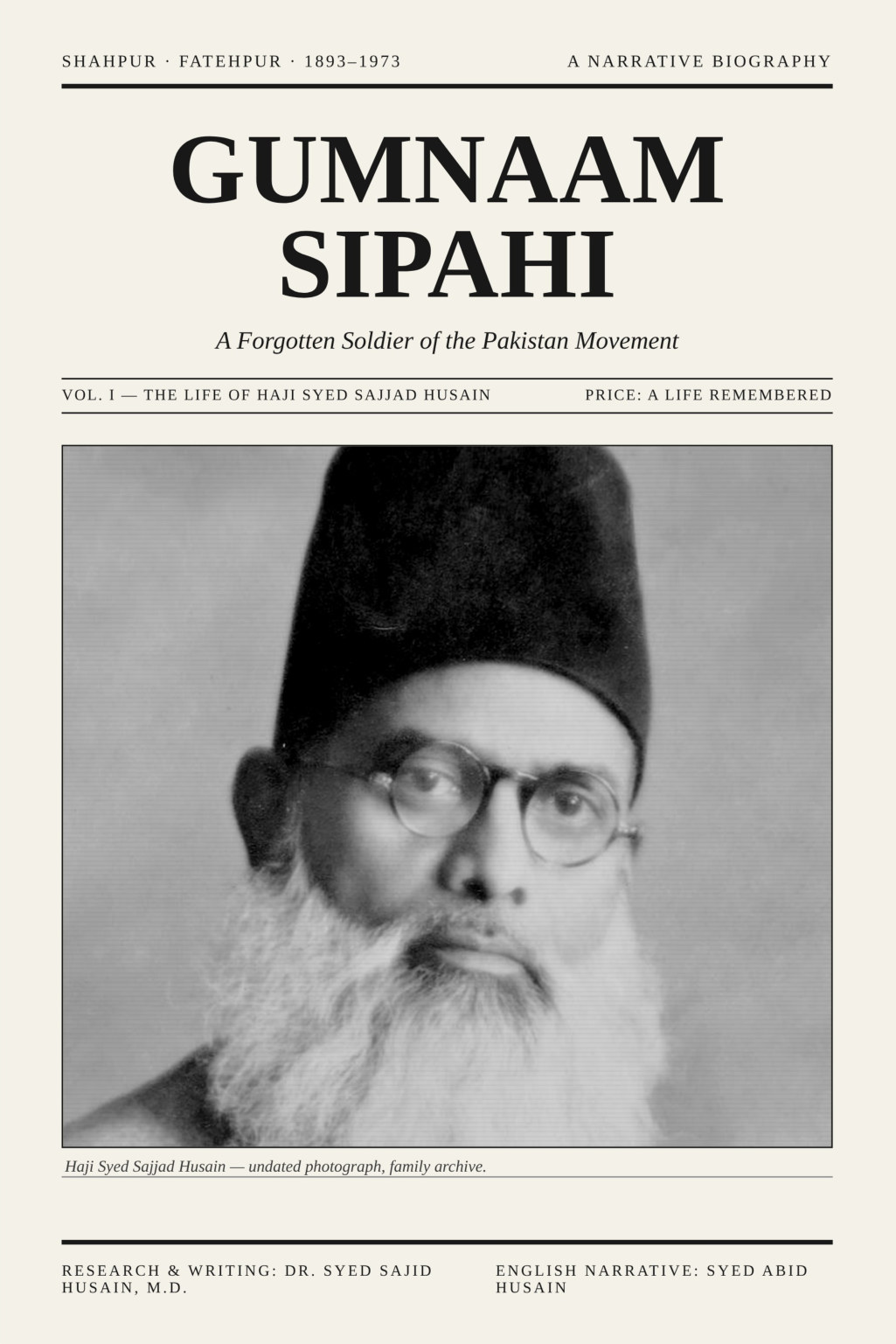
Haji Syed Sajjad Husain never commanded a rally, never signed a treaty, and never appears in the history books that record how Pakistan came to be. He was a small-town worker in Shahpur and Fatehpur — a man of trade, faith, and family — who gave the Pakistan Movement his time, his household, and his loyalty, and asked for nothing in return. When independence came, he crossed a new border with almost nothing else.
Gumnaam Sipahi — "The Forgotten Soldier" — is his story, gathered across decades by his grandson from family papers, photographs, and the recollections of those who knew him, and rendered here into English so that a family now scattered across continents can still meet the man at its root. It is a portrait of an ordinary life lived at the center of an extraordinary moment: of migration and loss, of quiet devotion, of a household held together through hardship, and of one man's refusal to be counted for what he did not have.
Researched and written in Urdu by Dr. Syed Sajid Husain, M.D., and rendered into this English narrative edition by Syed Abid Husain, another grandson and translator — a family's continuing effort to make sure a forgotten soldier of the Pakistan Movement is forgotten no longer.
Contents
- A Note on This Book
- Translator's and Author's Note
- Dedication (from the Urdu edition)
- Preface, by Dr. Syed Sajid Husain
- Reason for Writing
- Prologue: A Modest Quarter in Karachi
Part One — Shahpur · 1893–1914
- An Orphan's Inheritance
- The University of Books
- Two Masters
- Safarun-Nisa
- Calcutta and the Contract
- Rawalpindi and Abdul Hakeem
- The Household Begins
Part Two — The Khilafat Years · 1914–1922
- Bread for the Enemy's Prisoners
- When the Caliphate Fell
- The Cloth They Burned
- Two Ounces of Meat
- Maulana Muhammad Ali's Grave
Part Three — Ink and Enterprise · 1922–1937
- Inqilab
- The Wardha Scheme and the League
- The Masjid, the School, and the Hospital
- When Quetta Fell
- Guests at His Table
Part Four — The Life of a Small Town · 1922–1940
- The Story of the Cow
- The Road to Mecca
- A Landowner's Ledger
- Poets, Historians, and the Life of the Mind
- The Water Works
- Kashmira-Abadwin and a Wedding
- The Educational Tradition of Fatehpur
Part Five — A Divided Nation · 1937–1956
- The Sound of the Word "Pakistan"
- Fire and Fracture
- Two Countries, One Family
- What He Would Not Claim
- The Order to Leave
- Migration
Part Six — Trials in Fatehpur · 1950–1956
- Two Elections
- The Timber Yard in Kanpur
- A Field Worth Fighting For
- Ordinary Days
- Saudi Riyals and the Family Ledger
- The Letter from Bahawalpur
- A Question of Principle
Part Seven — The Grandfather · 1956–1973
- The Boy Who Would Become a Doctor
- The Household
- Conversations with Friends and Elders
- The Inward Turn
- The Next Generation
- The History of Shahpur
- Memories of the Town
Part Eight — Grief and Devotion
- Abdul Hadi
- Lentils and Salt
- The Discipleship
- Solitude, Longing, and Love of Homeland
- A Tribute from a Fellow Traveler
- A House in Fatehpur
- Human Sympathy and Compassion
- Concern for Relatives and Neighbors
- A Recollection Concerning a Brother
- Muslim Social Life and Commitment
- Household Discipline and Hospitality
- Character, Humor, and Frank Speech
- A Stay in Rawalpindi
- The Beginning of Illness
- How This Book Came to Be
- In His Own Words
- Family Recollections and Everyday Life
- Gatherings in Shahpur, Remembered
- The Letter of 1956
- An Educator Remembered
- Further Recollections of Marriage
- The Theft in the House
- Resolving What Could Be Resolved
- A Second Pilgrimage