
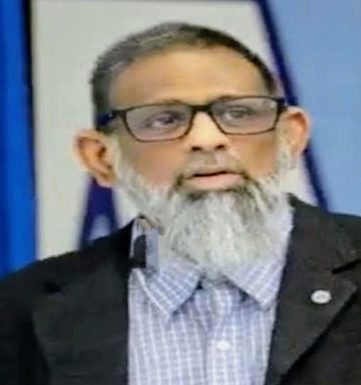
Community Pillar & Entrepreneur
In the heart of Maryland, where communities grew in pockets and stories often went untold, there lived a man who never sought the microphone, yet somehow shaped the sound of an entire generation’s voice. His name is Minhaj Hasan, and for decades he walked the corridors of community life with the steady calm of someone who understood that real leadership is rarely loud.
When Minhaj first stepped into the modest office of The Muslim Link, the newspaper was little more than a hopeful idea—ink, paper, and a dream that Muslims in the Greater Washington–Baltimore region deserved to see themselves reflected with dignity.
He didn’t arrive with fanfare. He arrived with a notebook, a sense of responsibility, and the quiet conviction that stories matter. Under his stewardship, the paper grew into one of the region’s most trusted Muslim community publications.
He trained young writers, edited late into the night, and insisted that every article, whether about a local bake sale or a national tragedy, carry honesty, clarity, and respect. Through his work, Muslim civic presence became normal, visible, and grounded in truth.
As Dar-us-Salaam expanded from a small community center into a full ecosystem of worship, education, service, and outreach, Minhaj found himself drawn into its inner workings.
Not because he asked.
Because people trusted him.
As Director of Donor Care and a member of the Shura, he became one of the institution’s most reliable stewards. He nurtured relationships with donors not through persuasion, but through sincerity. He believed that trust was the foundation of every strong institution—and he lived that belief in every conversation, every report, every late-night planning session.
He was the kind of leader who remembered names, who listened more than he spoke, and who always asked, “What will strengthen the community long after we’re gone?”
At Al-Huda School, Minhaj’s presence was felt in the hallways, in boardrooms, and in the countless decisions that shaped the school’s growth. He understood that education was not just about classrooms, it was about identity, continuity, and giving children a place where faith and learning could coexist with confidence.
Generations of families passed through the school’s doors, unaware that one of the quiet architects of their children’s environment was a man who preferred to stand in the back of the room, observing, supporting, ensuring.
When Cars4Jannah emerged as a creative charitable initiative, Minhaj saw not just a fundraising idea, but a chance to connect faith with action. As a board member, he helped shape its mission, ensuring that every donated vehicle translated into real, tangible benefit for those in need.
His voice appeared in podcasts and public discussions—not as a celebrity, but as a thoughtful guide on Muslim philanthropy, donor culture, and sustainable community funding. He spoke with humility, always centering the institution, never himself.
Though he never aligned himself with political slogans or partisan banners, Minhaj understood the importance of civic consciousness. Through journalism forums, media commentary, and community conversations, he helped Muslims navigate the complexities of public narratives, Islamophobia, and representation.
His philosophy was simple:
Empower people with information, and they will find their own voice.
Minhaj’s influence stretched far beyond titles. He moved between institutions—Dar-us-Salaam, The Muslim Link, Al-Huda School, Cars4Jannah, and countless Maryland Masajid—not as a figurehead, but as a bridge.
He was the person who connected dots, strengthened networks, and ensured that collaboration always outweighed competition. His leadership was not about being seen; it was about making sure the community saw itself clearly.
In the end, Minhaj Hasan’s legacy is not a single building, a single speech, or a single headline. It is the infrastructure he helped build:
- Media that told Muslim stories with dignity
- Institutions that earned donor trust
- Schools that shaped identity
- Philanthropy rooted in faith
- A community more confident in its voice
He never claimed to be a visionary, yet he helped shape a vision.
He never sought recognition, yet his work uplifted thousands.
He never asked for credit, yet his fingerprints remain on every corner of Maryland’s Muslim ecosystem.
And so, in the story of Maryland’s Muslim community, Minhaj Hasan stands as a quiet architect—a man who organized, built, guided, and protected with humility.
His leadership reminds us that some of the most important people in a community are those who never stand in the spotlight, because they are too busy making sure the lights stay on for everyone else.
With deep respect and gratitude, we honor Minhaj Hasan for a lifetime of service, humility, and unwavering commitment to Maryland’s Muslim community.