
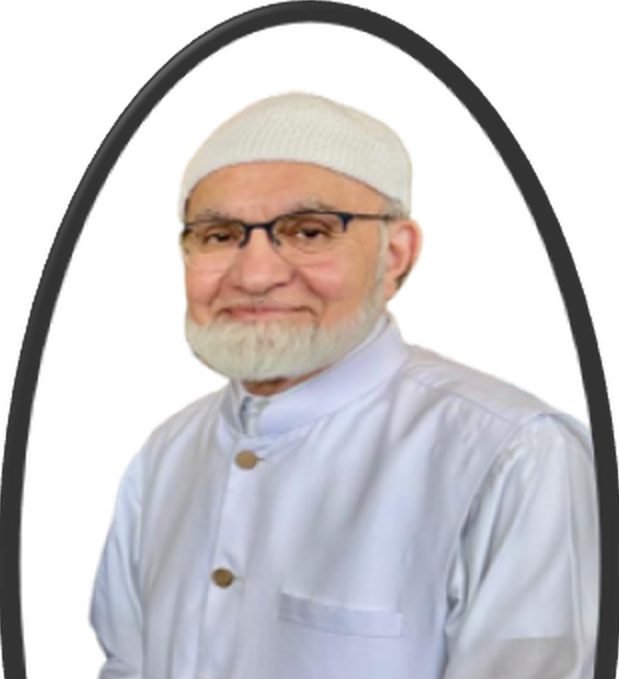
The Steady Builder
Some leaders arrive with powerful speeches. Others earn trust through consistency—returning whenever the institution needs a steady hand. Dr. Maqbool H. Patel belongs to the second kind.
His family roots extend to Gujarat, India, before his parents settled in Karachi, Pakistan. From that journey emerged a life shaped by discipline, education, faith, and personal responsibility. Trained as an engineer, Dr. Patel worked for many years at the University of Maryland, College Park, during the 1980s and 1990s. He later brought his technical and administrative experience to Coppin State University, where he held senior positions in facilities, capital planning, construction, contracts, and administration.
At Coppin, he helped reshape more than a university campus. His responsibilities included capital budgeting, master planning, property acquisition, construction management, government approvals, security infrastructure, utility systems, energy conservation, and coordination with public agencies and private contractors. New academic buildings, athletic facilities, renewable-energy projects, and neighborhood improvements strengthened both Coppin and the surrounding West Baltimore community.
Yet professional success never separated him from the masjid.
Dr. Patel served the Islamic Society of Baltimore as president during multiple terms—1987, 1993, 1999, 2009, and 2011. His repeated return to leadership reflected the community’s confidence in his judgment, experience, and ability to remain firm during demanding periods. His leadership was not driven by changing moods or personal popularity. It rested upon consistency, consultation, institutional discipline, and a clear understanding that every decision must serve generations beyond the present.
He belonged to the pioneering generation that helped transform ISB from a developing congregation into a permanent religious, educational, and community institution. He was among those who helped advance the construction of Masjid Al-Rahmah, Al-Rahmah School, and campus housing. His engineering background allowed him to understand what dreams required in practical terms: planning, permits, budgets, contracts, accountability, patience, and years of sustained effort.
But Dr. Patel understood that buildings alone could never preserve a community.
He played an important role in strengthening Al-Rahmah School, the Qur’an Academy, and the Sunday school. Through these institutions, children learned the Qur’an, developed Islamic character, and gained the confidence to live as Muslims in America. His commitment to educational excellence was therefore not limited to classrooms or academic credentials. It was rooted in the conviction that educated, faithful, and morally grounded children would become the strongest foundation of the community.
His service also extended to fundraising, public lectures, interfaith engagement, community outreach, and relationships with masajid and Muslim organizations across the country. He co-chaired Islamic Circle of North America conventions at the Baltimore Convention Center, helping bring together scholars, families, volunteers, and institutions from throughout the region.
On February 3, 2016, when President Barack Obama made his historic visit to the Islamic Society of Baltimore, Dr. Patel joined then-President Muhammad Jameel and other ISB leaders in welcoming him. At a moment when American Muslims faced growing suspicion and hostility, ISB stood before the nation as an established institution of faith, education, and civic responsibility. Dr. Patel’s presence represented decades of quiet work that had prepared the community for such a moment.
The State of Maryland recognized his contributions to education, community outreach, and faith-based service with a Governor’s Citation. Yet public recognition never appeared to alter the principles by which he lived. He remained modest, disciplined, and content within his means.
At home, he and his wife raised four accomplished daughters and two gifted sons. All six children pursued higher education, entered their respective professions, and established independent lives. Their accomplishments reflected a household in which education was expected, faith was practiced, and success was measured not only through professional standing but also through character, responsibility, and service.
Dr. Maqbool H. Patel’s legacy can be seen in two landscapes: the transformed campus of Coppin State University and the enduring institutions of the Islamic Society of Baltimore. In both places, he helped turn vision into structure and aspiration into lasting service.
His story is not simply about the offices he held or the buildings he helped construct. It is about consistency, the discipline to remain principled when circumstances changed, the patience to complete work that required years, and the wisdom to place education at the center of institutional life.
He did not merely help construct buildings.
He helped build continuity, confidence, and an educated generation prepared to carry the trust forward.
A Qur’anic Reflection
Dr. Patel’s life and accomplishments reflect Allah’s command:
“And say, ‘Work, for Allah will see your deeds, and so will His Messenger and the believers.’ Surah At-Tawbah, 9:105
This verse captures the spirit of his service. His abilities were not confined to knowledge or professional titles; they became visible through purposeful work—institutions strengthened, buildings completed, educational programs established, and generations prepared to carry the mission forward. His legacy demonstrates that sincere leadership is ultimately measured by beneficial deeds performed consistently, responsibly, and for the pleasure of Allah.