
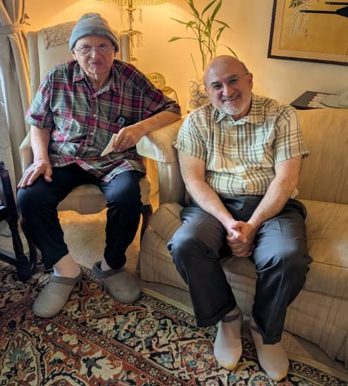
Life of Service and Faith
Dr. Salah Oweis was never a man to seek the spotlight, but his presence illuminated the lives of those around him. His journey began in Egypt, where his love for knowledge and faith was nurtured. A brilliant mind, he pursued his studies in mechanical engineering, eventually earning his PhD from Nagoya University in Japan in the mid-70s. His experiences in Japan added a unique dimension to his perspective—an appreciation for discipline, precision, and the quiet strength of humility.
In the 1980s, Dr. Oweis migrated to the United States, bringing with him the richness of his Egyptian roots and the wisdom of his time abroad. Settling in Baltimore, he recognized a need in the Muslim community—a need for guidance, for education, for connection. With steadfast dedication, he became one of the earliest organizers of Sunday school at the Islamic Society of Baltimore (ISB) in 1984, planting the seeds of knowledge in young hearts.
But his service did not stop there. Understanding the importance of preserving the Arabic language and heritage, he took ownership of regular Saturday Halaqas, creating a space for Arabic-speaking individuals to deepen their understanding of Islam. His gatherings were more than discussions; they were bridges between cultures, bringing people together from different backgrounds, united under a shared faith. His ability to weave the wisdom of Islamic teachings with the experiences of a diverse life made him a revered mentor.
Decades passed, and Dr. Oweis remained unwavering in his dedication. Whether leading at ISB or quietly offering counsel to those in need, he asked for nothing in return. He was a man whose sincerity spoke louder than words, a man whose humility made him beloved. He guided without arrogance, served without expectation, and taught with the wisdom of one who lived not for himself, but for the sake of others.
As life took its inevitable turns, age and health placed limits on his ability to be physically present in the community he cherished. His footsteps, once constant in the halls of ISB, became memories rather than echoes. Yet, his impact remained, carried forward by the very people he had nurtured students who had become teachers, followers who had become leaders. His legacy was not on accolades, but in the quiet, unwavering imprint he left on every heart he touched.
As he rests in the embrace of his home, surrounded by love and prayers, may he be granted the best in this life and the next. His journey, shaped by knowledge, faith, and service, is a testament to what it means to live with purpose. Dr. Salah Oweis is not just a name; he is a story of dedication, of cultural richness, and of unwavering belief—a story that will continue to inspire generations to come.