
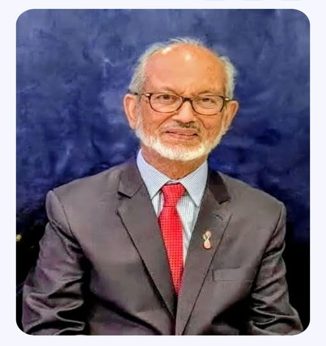
Life of Service, Scholarship & Devotion
Dr. Syed Hussain, PhD, embodies a generation of American Muslims who seamlessly wove faith into every aspect of professional and civic life. By day, he is a dedicated scientist at the National Institutes of Health (NIH), immersed in patient research and discovery. By evening and weekend, his presence is felt in the masājid and community circles of Silver Spring, Gaithersburg, and beyond—where steady, principled volunteers like him sustain the rhythm of communal life.
At the Muslim Community Center (MCC) and other local institutions, Dr. Hussain is remembered not for titles but for presence: attending meetings, supporting programs, and encouraging youth to pursue both Deen and Dunyā with excellence. His contributions to Islamic education, community development, and interfaith dialogue are marked by humility and clarity. In gatherings of Muslims, Christians, Jews, and others, his voice reflects a conviction that Muslims must stand as visible partners in building a just and compassionate society.
His engagement extends to College Park, where Muslim student life and chaplaincy have flourished under leaders like Chaplain Tarif Shraim. Dr. Hussain’s support has always carried a consistent principle: wherever young Muslims strive to preserve their faith and identity, elders must stand behind them with mentorship, resources, and heartfelt Duʿā.
Those who know him see a rare integration—the rigor of scientific training, the warmth of community service, and the sincerity of a believer who views every skill and credential as a trust from Allah. His legacy is not written in headlines but in years of quiet attendance, thoughtful advice, and steady support. He is remembered as a bridge: between generations, institutions, and the Muslim community and the wider world.
Dr. Hussain’s journey began in Warangal, India, where his father was a respected lawyer before Partition. A profound tragedy struck when his father passed away during surgery, leaving his mother—Ammajan—a widow with eight children. At just four years old, Dr. Hussain witnessed the family’s fortunes unravel as properties were lost and life shifted to Hyderabad. Through resilience and faith, Ammajan ensured her children were educated, married, and settled, preserving the family’s unity against immense challenges.
As a young man, Dr. Hussain pursued higher education in Wisconsin, then earned his PhD in pharmacology at the University of Missouri. Marriage followed, and his wife joined him in the rhythm of student life. Postdoctoral training took him to Indiana and Stanford, with each stage marked by the birth of a child. A tenured professorship was later attained in North Dakota, and eventually a distinguished role was held as a scientific research grant manager at the National Institute on Drug Abuse, part of the National Institutes of Health (NIH).
Now in his eighth decade, Dr. Hussain has turned his determination toward completing the “Choti Masjid” in Warangal, a city located about three hours from Hyderabad, India. Warangal is remembered as the city where his childhood was spent, where his father had been recognized as a successful lawyer in the pre-Partition era, and where his family—a household of eight children—once lived comfortably.
This project, envisioned as sadaqah jariyah—a continuous charity—represents his enduring commitment to faith and community. Such drive, dedication, and love are reflected throughout his journey. A life that began in India and was rebuilt in America has been poured generously back into society—through citizenship, professional contributions, raising a family, and remaining involved with grandchildren and local communities.
His journey resonates with the Qur’anic reminder that true success lies in faith and righteous deeds that endure beyond one’s lifetime:
"And make us leaders for the righteous." (Qur’an 25:74)
Dr. Hussain’s life reflects this prayer—quiet leadership, service without seeking recognition, and devotion that inspires generations to come.