
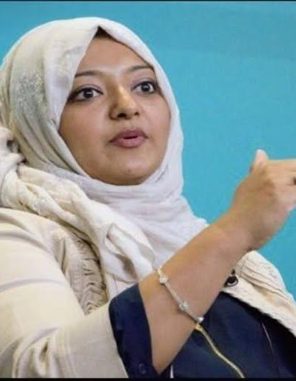
When Conscience Becomes Courage
Some people encounter injustice, feel its weight, and quietly move on. Others cannot rest while unanswered questions remain. Rabia Chaudry belongs to the second group.
A Pakistani American attorney, author, advocate, and nationally recognized storyteller, Rabia built her public life around a conviction that justice must be pursued with courage—especially when the person seeking it has little power, limited resources, or no public voice. Her journey demonstrates what can happen when conscience becomes determination and determination develops into leadership.
Her name became known throughout the United States because of her relentless advocacy for Adnan Syed, a family friend convicted in 2000 of murdering Baltimore County high school student Hae Min Lee. Rabia never accepted that every important question surrounding the case had been adequately answered. Long before millions of listeners knew Adnan’s name, she examined records, questioned the evidence, contacted journalists, consulted attorneys, and urged others to look more closely.
What began as one woman’s refusal to remain silent eventually became a national conversation about criminal justice, legal representation, evidence, media responsibility, and the human consequences of a disputed conviction.
The Foundation of a Fearless Voice
Rabia’s determination did not emerge in isolation. Its roots can be traced to the sacrifices, discipline, and real-life lessons of her immigrant family.
Her father, Dr. Anwarul Haq Chaudry, was a trained veterinarian who had served as curator of Pakistan’s National Zoo. He left Pakistan for the United States while his wife and newborn daughter remained behind, hoping to establish enough financial stability for his family to join him. His professional qualifications did not immediately open doors in America. Like many educated immigrants, he initially accepted work far below his training and endured the frustration of beginning again in an unfamiliar country.
After approximately a year, Rabia and her mother were able to join him. The family’s early years in America were financially difficult. Both parents worked multiple jobs, and neither initially enjoyed the dignity of working fully within a chosen profession. Eventually, Dr. Chaudry found an opportunity to practice veterinary medicine in Potomac, Maryland. That opening helped him rebuild the professional life he had sacrificed through migration. [Rabia Chaudry’s account of her family’s immigration experience](https://www.newageislam.com/islam-sectarianism/rabia-chaudry/one-familys-experience-it-takes-hate/d/12925)
His journey taught his children lessons that no classroom could fully provide: education matters, but credentials alone do not remove every obstacle; disappointment must not become defeat; dignity can be preserved through difficult work; and progress sometimes requires beginning again without surrendering one’s identity.
Rabia has remembered her father not only as a veterinarian and provider, but as a constant presence in her life—a man whose perseverance survived migration, professional setbacks, financial struggle, and the responsibilities of raising a family in a new country. He had grown up in a middle-class Punjabi family, excelled in cricket, and chose veterinary education despite family expectations that he pursues conventional medicine. Even in his youth, he had demonstrated the independence to follow a path others did not necessarily understand. [“A Gift for Abu,” Rabia Chaudry’s reflection on her father](https://www.patheos.com/blogs/splitthemoon/2014/06/a-gift-for-abu/)
Within this immigrant household, Rabia and her siblings learned through lived experience. They watched their parents work, adjust, sacrifice, and rebuild. Education was important, but so were courage, adaptability, loyalty, and the willingness to engage people beyond familiar religious and cultural boundaries.
The family’s development was also influenced by acts of kindness that crossed lines of faith. A Christian friend helped sponsor their immigration, while an older Jewish veterinarian helped Dr. Chaudry enter the American veterinary profession and offered the family a nearby place to live. Such experiences taught the children that character cannot be judged by religious labels alone. Friendship, fairness, and generosity could overcome inherited suspicion and create lasting human bonds.
These lessons would later become visible in Rabia’s professional life: defend the vulnerable, resist simplistic assumptions, build relationships across communities, and judge people according to their conduct rather than their identity.
Education as Preparation for Service
Growing up in America required Rabia to navigate the expectations of a Pakistani immigrant family while learning to find her own voice in American society. She experienced the loneliness of being one of relatively few South Asian students in school and the pressures of balancing family, culture, faith, education, and belonging.
She attended the University of Maryland, Baltimore County, earning her undergraduate degree before receiving her law degree from George Mason University. She then practiced immigration and civil-rights law for more than a decade, representing people whose futures could depend upon whether someone was willing to listen carefully, examine the facts, and stand beside them. [Rabia Chaudry’s official biography](https://rabiachaudry.com/about/)
The law gave her professional tools, but her family had already given her deeper training: endurance when institutions seem immovable, confidence when others dismiss your concerns, and faith that difficult circumstances do not determine the limits of a person’s future.
The Case That Would Not Let Her Be Silent
The murder of Hae Min Lee was a devastating tragedy. A young woman lost her life, and her family was left with grief that no legal proceeding could erase. Any responsible account of Adnan Syed’s case must begin by recognizing Hae’s humanity and the permanent suffering experienced by those who loved her.
Adnan, who had been part of Rabia’s wider community and was a close friend of her younger brother, was arrested, prosecuted, and convicted. He maintained his innocence. Rabia believed that the case against him contained unresolved contradictions and that his defense had failed to investigate important information adequately.
For years, she carried the case beyond the attention span of the public. She reviewed documents, pursued leads, sought legal assistance, and tried to persuade journalists to examine what she believed had gone wrong. Her persistence was not glamorous. Much of it unfolded away from cameras and recognition, during years when few people outside the families and local community were paying attention.
This is where leadership is often revealed—not after the audience arrives, but during the lonely years when no audience exists.
Rabia could have concluded that the courts had spoken and that nothing more could be done. Instead, she treated the conviction as a call to responsibility. She kept asking questions, not because questioning guaranteed success, but because silence would have meant abandoning what she believed to be true.
From a Maryland Case to a National Conversation
Rabia eventually brought the case to journalist Sarah Koenig. That introduction led to the first season of the podcast Serial in 2014. The program reached an enormous national and international audience, transforming a Baltimore-area murder case into one of the most widely discussed criminal cases in modern American media.
Millions of listeners began examining testimony, timelines, telephone records, legal strategy, memory, and reasonable doubt. The case inspired debate far beyond Maryland and helped demonstrate the power of long-form audio storytelling.
Yet Rabia’s role was greater than introducing the story to a journalist. She continued researching and advocating after Serial ended. She co-founded and hosted the podcast Undisclosed, which examined Adnan’s case and other contested convictions in greater legal detail. She later wrote Adnan’s Story: The Search for Truth and Justice After Serial, which became a New York Times bestseller, and served as an executive producer of the HBO documentary series The Case Against Adnan Syed. [Rabia Chaudry’s official biography](https://rabiachaudry.com/about/)
Through these platforms, she demonstrated that storytelling can become a form of civic advocacy. A legal record may be preserved in court files, but a human story can carry that record beyond the courthouse, inviting the public to examine how justice is administered and whom the system may fail to hear.
Determination Without a Simple Ending
The legal history that followed was long and complex. Adnan spent more than two decades in prison. His conviction was vacated in 2022, but subsequent appellate proceedings reinstated it because of issues involving the rights of Hae Min Lee’s family during the vacatur process. In February 2025, the Baltimore City State’s Attorney withdrew the earlier motion to vacate while supporting resentencing under Maryland’s Juvenile Restoration Act. In March 2025, the court reduced Adnan’s sentence to life with all but time served suspended and imposed five years of supervised probation. His conviction therefore remained in place, although he was not returned to prison. [Baltimore City State’s Attorney’s February 2025 statement](https://www.stattorney.org/media-center/press-releases/3042-state-s-attorney-announces-withdrawal-of-motion-to-vacate-judgement-in-adnan-syed-case), [March 2025 resentencing statement](https://www.stattorney.org/media-center/press-releases/3043-state-s-attorney-issues-statement-on-judge-s-decision-to-re-sentence-adnan-syed)
The outcome did not provide the simple ending that advocates on either side may have desired. Rabia’s lasting importance, however, does not depend solely upon a single court ruling. It lies in her refusal to allow a consequential case to disappear without sustained scrutiny.
Her work showed that ordinary citizens, families, attorneys, journalists, and advocates can bring national attention to questions that institutions may consider settled. It also demonstrated the complexity of justice: the rights of the accused, the suffering of victims’ families, procedural fairness, public accountability, and the search for truth must all be taken seriously.
A Broader Life of Leadership
Although the Adnan Syed case made her nationally known, Rabia’s career extends well beyond it.
She practiced immigration and civil-rights law, including advocacy for Muslim immigrants confronting federal law-enforcement agencies. She founded the Safe Nation Collaborative, which worked with Muslim communities and government institutions on national security, cultural competency, and countering violent extremism. Her work involved agencies and organizations at the local, state, and national levels, including the Maryland State Police and Washington-area law-enforcement institutions.
She later became a fellow at the New America Foundation and a Jennings Randolph Senior Fellow at the United States Institute of Peace. Her work addressed Muslim civic empowerment, violent extremism, public policy, media advocacy, and the need for communities to tell their own stories rather than allowing others to define them.
Rabia also participated in Muslim-Jewish bridge-building and interfaith initiatives. Those commitments reflect the formative experiences of her own family, whose early survival in America was aided by Christian friendship and Jewish generosity. The lesson received by an immigrant child became the practice of an adult leader: communities become safer and stronger when people cross boundaries, confront prejudice, and work together without surrendering their principles.
As an author, Rabia later revealed another form of courage in Fatty Fatty Boom Boom: A Memoir of Food, Fat, and Family. With candor and humor, she explored immigration, Pakistani family life, food, body image, marriage, motherhood, and her evolving relationship with herself. The memoir showed that strength does not require hiding vulnerability. Sometimes leadership means speaking publicly about private struggles so that others feel less alone.
One of Maryland’s Shining Threads
Rabia Chaudry’s story belongs within Maryland’s Muslim history because it connects immigrant sacrifice, family education, professional achievement, civic advocacy, media innovation, and the pursuit of justice.
Her father crossed an ocean, endured professional disappointment, and rebuilt his life through persistence. Rabia inherited that refusal to be defeated. From her parents and family, she learned that education must be joined with courage, that faith must produce service, and that hardship can become training for a larger responsibility.
She transformed concern for a family friend into a national examination of the criminal-justice system. She used legal knowledge, media, writing, podcasts, and public advocacy to give a disputed case a voice far beyond Baltimore. Whether one agrees with every conclusion she has reached or every position she has defended, the force of her determination cannot be denied.
Rabia’s life offers a lesson for the generations that follow: leadership is not waiting for permission to speak. It is accepting responsibility when conscience will not allow silence. It is returning to the unanswered question, opening the neglected file, standing beside the person who feels forgotten, and continuing even when the road is long and the outcome uncertain.
Her story is a shining thread of persistence—woven from the sacrifice of immigrant parents, strengthened by education, tested through controversy, and carried forward by an unwavering belief that justice deserves more than passive hope.
It demands courage, work, and the determination to keep searching.