Story of Eternal Legacy
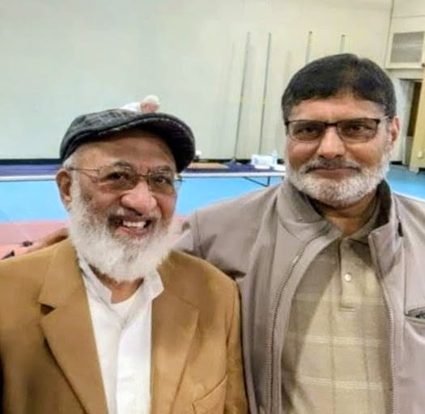
The humidity of that morning in August 1970 clung to Iqbal Marfani's shirt as he stepped off the plane in Maryland. At twenty-something years old, with a head full of dreams and a heart shaped by service, he carried little more than a suitcase and the values instilled in him from his days volunteering with the Edhi Foundation back in Karachi. He had left behind the bustling streets near the Rangoonwala Center, where he'd spent countless hours teaching vocational skills to those who needed them most. America was new, unfamiliar—but the call to serve was as familiar as his own heartbeat.
By the 1980s, Iqbal had found his footing. His accounting degree from the University of Baltimore opened doors, and soon he was working in the Corporate Tax office in the Comptroller of Maryland—a job he would hold with quiet dedication for thirty-five years. But evenings and weekends? Those belonged to something bigger.
At Shaffer Hall in Johns Hopkins University, Baltimore, a small group of Muslims would gather—temporary meetings, borrowed spaces, but permanent dreams. Iqbal was there, among the founders of what would become the Islamic Society of Baltimore. When the groundbreaking ceremony came, he stood with a shovel in hand, his conservative accountant's mind already calculating how to make every dollar count, how to build something that would last.
"Brother Iqbal," someone once joked at a fundraiser, "you squeeze a dollar so tight, the eagle screams!"
Iqbal's response was immediate, his eyes flashing with that famous short temper. "You want to build a masjid or a mansion? We answer to Allah for every penny!" But five minutes later, he'd thrown his arm around the same man's shoulders, laughing. "Come, come, let's have chai. I'm sorry, brother. You know how I am."
Everyone did know. They knew that behind the strict adherence to rules and the occasional sharp word was a man who would give his last dollar—carefully counted, of course—to help someone in need.
As the years passed, Iqbal's vision expanded southward. Annapolis needed a masjid. In a rented space on the upper level of a shopping center, the Islamic Society of Annapolis was born. Every Friday, Juma prayers echoed through what had once been retail space. Soon came Sunday classes, then Quran tafseer sessions that ran late into the evening.
His friends—Rashid Iqbal, and Saeed Iqbal—stood beside him. His wife stood behind him, sacrificing twenty-five years of their marriage to his mission, understanding that sometimes a man must build for his community what he cannot fully give to his home.
The real triumph came with the Mecca Learning Center. Twenty acres in Gambrills, Maryland—an impossible dream made real through Iqbal's relentless fundraising and the expertise of Rizwan Siddiqui and other construction professionals. While others might have taken loans, Iqbal's conservative approach meant MLC would be debt-free.
"Debt is chains," he'd say, his accountant's mind and his faith perfectly aligned. "We build free, or we don't build at all."
When someone once suggested a more expensive flooring option, Iqbal's voice rose sharply: "This is a house of Allah, not a palace! People should focus on their prayers, not the tiles!" The committee member looked annoyed. Ten minutes later, Iqbal was walking him to the car, hand on his shoulder. "Brother, forgive me. You have a good heart. Let's pray together next week, yes?"
The Quran he loved so deeply taught him:
"The masjids of Allah are only to be maintained by those who believe in Allah and the Last Day and establish prayer and give zakah and do not fear except Allah." (Quran 9:18)
Iqbal lived these words. Masjid Al-Ansar in Annapolis became a satellite location when the community grew. When death came calling, as it inevitably does, Iqbal secured a cemetery in Glen Burnie—two hundred graves, purchased and donated to ISA. Later, as the community expanded, more plots were added. Even in death, he wanted his community cared for.
Back in Karachi, people still spoke of his generosity. His Dhoraji Students Organization work serving the Memon community. His distant relation to Miftah Ismail, the economist and politician, was mentioned with pride by others, though Iqbal himself rarely brought it up. "Family is family," he'd say with a shrug. "We each serve in our own way."
On a humid summer evening not unlike that first August day in 1970, Iqbal stood at the Mecca Learning Center, watching children run through the courtyard after Islamic school. His short temper had mellowed with age, though it still flared when someone parked in the handicapped spot without permission, or when fundraiser money wasn't properly accounted for. But the hugs came quicker now, the apologies easier.
"You know what I learned at Rangoonwala Center all those years ago? Give people skills, give them dignity, give them a place to grow—that's how you serve humanity. A masjid is the same. It's not just a building. It's where people learn to be better. Where they find their way."
When winter came in 2022, Iqbal Marfani returned to his Creator. The news spread through the Maryland Muslim community like ripples across still water. From Baltimore to Annapolis, from the Islamic Society of Baltimore (ISB) to the Mecca Learning Center, from Masjid Al-Ansar to the cemetery in Glen Burnie—the very spaces he had built—the community gathered to remember.
"O reassured soul, return to your Lord, well-pleased and pleasing [to Him]. Enter among My [righteous] servants and enter My Paradise." (Quran 89:27-30)
May Allah forgive Iqbal Marfani and grant him the highest place in Jannah. May his legacy of service continue to inspire generations. Ameen!