
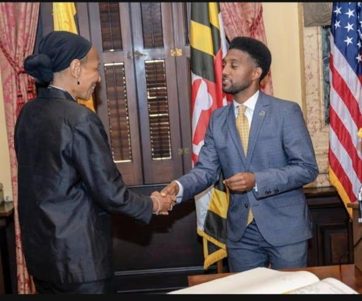
Portrait of Justice, Faith & Dignity
Honorable Zakia Mahasa stands as one of the most influential Muslim public servants in Maryland’s modern history. Her rise from a young college student exploring her identity to becoming the first Muslim woman—and the first hijabi Muslim woman—to preside over an American courtroom is a testament to courage, conviction, and excellence.
As an undergraduate at the University of Maryland in the late 1970s, Zakia discovered Islam in a deeply personal way. The faith’s emphasis on justice, inner dignity, and disciplined living resonated with her sense of purpose. She embraced Islam and chose to wear the hijab long before seeing anyone who looked like her in high-profile legal roles. It was a decision that would later become symbolic for a generation of Muslim women seeking role models in civic leadership.
She completed her bachelor’s degree in 1981 and went on to earn her Juris Doctor from the University of Maryland Carey School of Law in 1986. From the very beginning, she saw the law not as a career ladder, but as a means to serve people with fairness and compassion.
Zakia began her legal career at the Legal Aid Bureau of Maryland (1987–1992), representing low-income individuals who lacked access to the justice system. Her early cases—spanning housing disputes, family struggles, and crisis intervention—gave her deep insight into the challenges faced by Baltimore’s working-class families.
Her work at the House of Ruth Domestic Violence Legal Clinic from 1992 to 1997 further shaped her understanding of trauma, resilience, and the high stakes of intimate-family disputes. As both staff attorney and supervising attorney, she helped guide countless women through legal pathways toward safety and protection.
These experiences cemented her belief that legal service is a form of amānah, a trust from Allah , demanding integrity, patience, and empathy.
In 1997, Zakia Mahasa made history when she was appointed Master in Chancery (Magistrate) for the Circuit Court for Baltimore City, Juvenile & Family Division. With this appointment, she became widely recognized as the first hijab-wearing Muslim woman to preside over a courtroom in the United States.
For the next twenty-one years, her courtroom became a place of clarity and dignity. She handled some of the most sensitive areas of the law—child abuse and neglect, foster care, custody disputes, juvenile delinquency—often with a docket of 10 to 30 cases a day. Through it all, she displayed a calm presence rooted in principle. She treated each child and parent not as a statistic, but as a soul whose future could be shaped by a single judicial decision.
Her presence on the bench shattered stereotypes. The sight of an African American Muslim woman in hijab, firm yet compassionate, became a quiet revolution in American legal culture.
In 2018, the U.S. Department of Justice appointed her as an Immigration Judge with the Baltimore Immigration Court. Here, she began presiding over some of the most emotionally charged cases in modern law—matters involving asylum, deportation, family separation, and humanitarian protection.
Her years of juvenile and family work prepared her for these high-stakes decisions. She continued to emphasize dignity, clarity, and thoughtful application of the law, aware that each ruling affected not just individuals but entire families and generations.
Beyond the courtroom, Judge Mahasa has been a speaker, educator, and mentor. She has addressed Muslim women’s leadership programs, domestic violence conferences, interfaith events, and university seminars—encouraging Muslim women to pursue law, speak confidently, and remain unapologetically faithful.
Her message is consistent:
“Be grounded in your identity, be excellent in your work, and let your presence itself break barriers.”
In 2022, she expanded her civic service as a Trustee of the Baltimore City Employees’ and Elected Officials’ Retirement Systems, helping safeguard the long-term financial security of thousands of public workers.
Judge Zakia Mahasa’s legacy reaches far beyond legal rulings. She symbolizes what becomes possible when faith and professional excellence reinforce each other. Her career demonstrates that modesty and authority are not opposites, that hijab and leadership coexist naturally, and that the American judiciary is enriched by diverse voices shaped by strong moral traditions.
Her life stands as an inspiration for young Muslim women, African-American professionals, law students, public servants, and all who seek to serve with dignity.
She entered the courtroom as a pioneer. She remained as a guardian. And she leaves a legacy as one of Maryland’s most important Muslim trailblazers.
To reflect the spirit of justice and truth that defines her life’s work, the following verse is profoundly appropriate:
“O you who believe! Stand firmly for justice, as witnesses for Allah, even if it be against yourselves. Surah An-Nisa (4:135)
A verse that mirrors her journey: standing for justice with unwavering integrity, carrying the weight of responsibility with grace, and embodying the dignity that Allah commands of those entrusted with power.