Life of Service & Justice
In the story of Maryland’s Muslim communities, certain individuals appear not simply as leaders, but as connectors—people who hold together the threads of worship, education, civic engagement, and global justice. Dr. Rehan A. Khan of Harford County stands firmly among them. His journey weaves the discipline of medicine with the devotion of community building and the courage of public advocacy, forming a legacy that continues to shape Masjid Al-Falaah and the wider Muslim landscape of Maryland.
Before he ever stood at a podium or led a board meeting, Dr. Khan was known as a physician who listened. In Harford County, where he established urgent-care and pain-management clinics, he earned the reputation of a healer who treated patients with empathy, patience, and dignity. Whether through the Rehabilitation and Pain Management Center of Maryland or MD Immediate Care in Havre de Grace, his medical work reflected a belief that caring for the sick is among the highest forms of service.
His training—an M.D. complemented by a master’s degree—equipped him with clinical skill, but his community instinct came from a deeper source: the conviction that Muslims in America thrive when their institutions are strong, their children empowered, and their values visible in the public square.
Building the First Masjid of Harford County
When Muslim families in Harford County dreamed of a stable spiritual home, Dr. Khan became one of the hands that turned that dream into concrete reality. As President of Masjid Al-Falaah—the first masjid established in the county—he guided the Harford County Education Society (HCES) through years of gradual growth, community organizing, property acquisition, and planning.
Under his leadership, Masjid Al-Falaah evolved into a vibrant nexus of Islamic life:
- A place of inclusiveness and hospitality, where neighbors of all backgrounds felt welcomed.
- A center of sacred learning, home to the American Institute of Qur’an, offering ḥifẓ, part-time Qur’an studies, and a flourishing Sunday school.
- A civic and interfaith bridge, known for Ramadan open houses, county-wide Eid gatherings, and partnerships with public officials, churches, synagogues, and service groups.
Dr. Khan’s leadership style was calm, methodical, and rooted in principle. He avoided personality-centered activism; instead, he focused on system-building, ensuring that the masjid would outlive any one individual and remain a stronghold for future generations.
At a time when many American masjids struggled to balance faith with civic responsibility, Dr. Khan offered a thoughtful model. He insisted that Masjid Al-Falaah remain non-partisan, preserving the integrity of its nonprofit mandate, but he also urged community members to participate fully in civic life—to vote, volunteer, engage local leadership, and contribute to the future of their county.
His interfaith work blossomed during events such as Harford County’s Martin Luther King Jr. Day celebrations, where he spoke of Prophet Abraham, Moses, Jesus, and Muhammad—peace be upon them all—as shared guides in a single human family. His voice emphasized coexistence, compassion, and ethical partnership between communities. These gatherings built real relationships—anchoring the Muslim presence in Harford County as a respected and reliable partner.
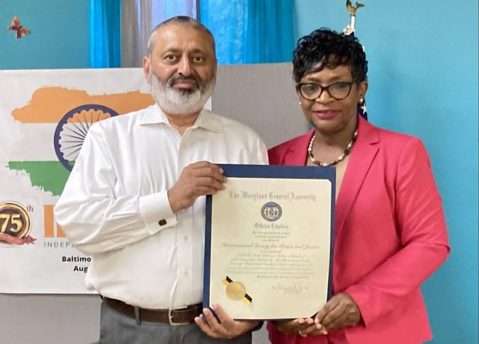
If Masjid Al-Falaah grounded Dr. Khan in local service, the International Society for Peace and Justice (ISPJ) projected his voice onto national and international platforms. As President of ISPJ, he helped frame critical conversations about the Babri Masjid demolition, the Gujarat 2002 pogrom, rising Hindutva extremism, and systemic violence against minorities in India.
He became a respected voice in coalitions with CAIR, Justice For All, IAMC, academic leaders, human-rights activists, and faith-based networks across the U.S. His advocacy included:
- Urging the U.S. government to formally recognize the Gujarat violence as genocide.
- Condemning mob attacks and discriminatory laws such as CAA/NRC.
- Standing publicly with historians and scholars targeted by extremist groups.
- Defending exploited migrant workers in cases of labor abuse.
His work showed that Islam’s moral compass is not limited by borders; it calls believers to stand with the oppressed wherever they may be.
Despite his many roles—physician, masjid president, educator, civic leader, interfaith partner, human-rights advocate—Dr. Rehan Khan is known for humility and quiet dedication. He is not a man who seeks the spotlight; rather, he becomes visible only when the community needs his guidance, clarity, and principled presence.
Families recall how he welcomed newcomers, mentored young volunteers, and encouraged students in their Qur’an learning. Local officials recognize him as a constructive, thoughtful partner. Human-rights groups regard him as a reliable ally in the struggle for justice.
His life stands as a reminder that leadership does not begin with titles; it begins with sincerity. In the tapestry of Maryland’s Muslim history, Dr. Rehan Khan’s chapter is one of courage, compassion, and unwavering commitment to the belief that serving people is a form of worship—and that justice, peace, and dignity are expressions of faith in action.